

The bank collateral channel of monetary policy: evidence from securities losses
by Mariassunta Giannetti, Martina Jasova, Caterina Mendicino and Dominik Supera[1]
When the central bank raises interest rates, securities held by banks lose market value. During the 2022-23 tightening cycle, this reduced secured funding for banks through a bank collateral channel, hitting hardest the banks with limited liquidity buffers and high collateral utilisation, resulting in a more pronounced contraction in lending. Internal capital markets partly mitigated this, but only for domestic subsidiaries, as cross-border liquidity transfers remained limited.
Why do securities losses matter for monetary policy transmission?
The collapse of Silicon Valley Bank in 2023 highlighted the financial stability risks of large valuation losses following sharp increases in interest rates. Depending on a bank’s capital and funding structure, such losses can erode confidence, trigger bank runs or even failure (Jiang et al., 2024). The debate has thus focused on their implications for bank capital and financial stability (Dewatripont et al., 2023; Acharya et al., 2023).
In the euro area, however, banks entered the 2022-23 tightening cycle with strong capital positions (Enria, 2023). Yet, in Giannetti et al. (2026), we show that securities losses also impact the liquidity of banks’ balance sheets and credit supply, and thus monetary policy transmission – even without financial stability concerns.
The mechanism is a bank collateral channel: declines in the value of securities eligible as a collateral can reduce banks’ access to liquidity, prompting a precautionary tightening of lending as banks preserve capacity to withstand future liquidity shocks (e.g. Gertler and Kiyotaki, 2015; Bianchi and Bigio, 2022).
How big a shadow do securities losses cast on euro area banks?
Our analysis builds on a comprehensive euro area dataset covering securities holdings, interbank borrowing and lending, corporate loans, and supervisory balance-sheet information from the first quarter of 2022 to the third quarter of 2023.
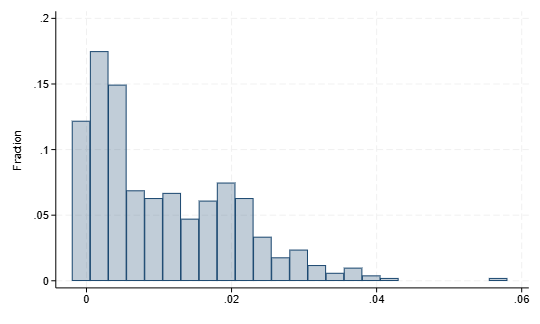
Using detailed security-level information, we calculated how rising interest rates reduced the value of banks’ securities portfolios.[2] By the third quarter of 2023 euro area banks had lost on average around 1% of total assets, or 12% of total equity, with he largest losses on securities held at amortised cost (held-to-maturity).[3] Losses varied considerably across banks (Chart 1), largely reflecting differences in the size and maturity of their securities holdings: banks with more long-term fixed income securities saw the largest declines.
Chart 1
Securities losses vary across banks
Distribution of securities losses across euro area banks
(share of banks)
Source: Giannetti et al. (2026).
Notes: The chart shows the distribution of the securities losses accrued between the first quarter of 2022 and the third quarter of 2023, expressed as a share of total assets in the first quarter of 2022, i.e. before the start of the ECB’s monetary policy tightening cycle. Each bar represents the share of banks whose securities losses fall within a particular range.
Shedding light on the bank collateral channel of monetary policy
Euro area banks fund an average of 14% of their assets through interbank borrowing. We show that banks with larger security losses received significantly less interbank secured funding: a one standard deviation increase in losses was associated with an almost 4% decline in interbank borrowing.
Several findings point to collateral constraints as the underlying mechanism: only losses on collateral-eligile securities mattered; effects were concentrated in secured funding: and the impact was greater for banks that relied heavily on securities as collateral before the tightening cycle.
The results do not appear driven by bank capital. Less well-capitalised banks did not reduce their lending more, and losses on securities held at amortised cost, which do not affect regulatory capital, had similar effects to losses on securities at market value. Losses on other assets and liabilities did not affect interbank borrowing.
These findings suggest that the bank collateral channel is the main mechanism linking securities losses to banks’ borrowing capacity, implying that monetary policy transmits not only through funding costs and capital, but also through the value of collateral that banks use to obtain liquidity.
Clouding the horizon for lending to firms
Reduced access to liquidity has direct consequences for credit supply to firms. Using loan-level data and controlling for firm-specific credit demand (Khwaja and Mian, 2008), we find that banks with larger securities losses reduced lending to firms more than others: a one standard deviation increase in losses is associated with a 2.5% decline in corporate lending. Firms could not fully offset the impact by borrowing from less-affected banks, implying a contraction in overall credit supply. Affected banks also charged higher rates and offered shorter maturities, with the contraction concentrated among banks with limited liquidity buffers, high collateral utilisation, or greater future liquidity needs.[4]
Previous work has focused on the effects of securities losses on bank net worth and capital (e.g. Rodnyansky and Darmouni, 2017; Acharya et al., 2018; Gomez et al., 2021; Jasova et al., 2024; Greenwald et al., 2024). We show that they also restrict banks’ access to interbank funding, with direct effectsfor lending. More broadly, collateral values are thus an important, and overlooked, channel of monetary policy transmission.
Banking groups shelter banks closer to home
Banking groups can channel liquidity to subsidiaries via internal capital markets. We find that intragroup funding helped offset securities losses for domestic subsidiaries, but not foreign ones, whose lending contracted almost as much as stand-alone banks. This points to an organisational pecking order within euro area banking groups, unlike US global banks (Cetorelli and Goldberg, 2012), with liquidity not systematically allocated to subsidiaries with the strongest opportunities.
These results suggest that internal capital markets remain segmented along national lines, reflecting national deposit insurance arrangements and country-specific liquidity requirements that limit cross-border liquidity reallocation within the euro area.
The collateral channel matters for monetary policy
Our analysis demonstrates the role of collateral values in monetary policy transmission, even for well-capitalised banks. It also points to a need for further financial integration: since banking groups struggle to reallocate liquidity across borders, monetary policy may affect domestic and foreign subsidiaries differently, causing credit conditions to diverge between countries. Completing the banking union, including a common deposit insurance framework, would help make the transmission of monetary policy more even across the euro area.
References
Acharya, V., Eisert, T., Eufinger, C. and Hirsch, C. (2018), “Real Effects of the Sovereign Debt Crisis in Europe: Evidence from Syndicated Loans”, The Review of Financial Studies, Vol. 31, August, pp. 2855-2896.
Acharya, V., Richardson, M., Schoenholtz, K. and Tuckman, B. (eds) (2023), SVB and Beyond: The Banking Stress of 2023, CEPR Press, Paris & London, August.
Altavilla, C., Boucinha, M., Burlon, L., Giannetti, M. and Schumacher, J. (2025), “Central bank liquidity reallocation and bank lending: Evidence from the tiering system”, Journal of Financial Economics, Vol. 168, Article 104058.
Bianchi, J. and Bigio, S. (2022), “Banks, Liquidity Management, and Monetary Policy”, Econometrica, Vol. 90, No 1, January, pp. 391-454.
Cetorelli, N. and Goldberg, L.S. (2012), “Liquidity management of U.S. global banks: Internal capital markets in the great recession”, Journal of International Economics, Vol. 88, No 2, November, pp. 299-311.
Dewatripont, M., Praet, P. and Sapir, A. (2023), “The Silicon Valley Bank collapse: Prudential regulation lessons for Europe and the world”, VoxEU.org, 20 March.
Enria, A. (2023), “Introductory statement”, speech at the press conference on the 2023 SREP results and the supervisory priorities for 2024-26, 19 December.
Gertler, M. and Kiyotaki, N. (2015), “Banking, Liquidity, and Bank Runs in an Infinite Horizon Economy”, American Economic Review, Vol. 105, No 7, July, pp. 2011-2043.
Giannetti, M., Jasova, M., Mendicino, C. and Supera, D. (2026), “Securities losses and the bank collateral channel of monetary transmission”, Working Paper Series, No 3209, ECB.
Gomez, M., Landier, A., Sraer, D. and Thesmar, D. (2021), “Banks’ exposure to interest rate risk and the transmission of monetary policy”, Journal of Monetary Economics, Vol. 117, January, pp. 543-570.
Greenwald, D., Krainer, J. and Pascal, P. (2024), “Monetary Transmission Through Bank Securities Portfolios”, Working Papers, No 32449, National Bureau of Economic Research.
Jasova, M., Laeven, L., Mendicino, C., Peydro, J.L. and Supera, D. (2024), “Systemic Risk and Monetary Policy: The Haircut Gap Channel of the Lender of Last Resort”, The Review of Financial Studies, Vol. 37, No 7, July, pp. 2191-2224.
Jiang, E., Matvos, G., Piskorski, T. and Seru, A. (2024), “Monetary tightening and U.S. bank fragility in 2023: Mark-to-market losses and uninsured depositor runs?”, Journal of Financial Economics, Vol. 159, September, Article 103899.
Khwaja, A.I and Mian, A. (2008), “Tracing the Impact of Bank Liquidity Shocks: Evidence from an Emerging Market”, American Economic Review, Vol. 98, No 4, pp. 1413-1442.
Rodnyansky, A. and Darmouni, O.M. (2017), “The Effects of Quantitative Easing on Bank Lending Behavior”, The Review of Financial Studies, Vol. 30, No 11, November, pp. 3858-3887.
Legal Disclaimer:
EIN Presswire provides this news content "as is" without warranty of any kind. We do not accept any responsibility or liability for the accuracy, content, images, videos, licenses, completeness, legality, or reliability of the information contained in this article. If you have any complaints or copyright issues related to this article, kindly contact the author above.
